Research
My research focuses on predictive autonomy for robots and autonomous vehicles operating in dynamic, interactive environments. The main themes are world models, model-based reinforcement learning, sampling-based model predictive control, and safety-aware planning under uncertain human motion.
Interaction-Aware World Models for Predictive Planning — PIP-CN
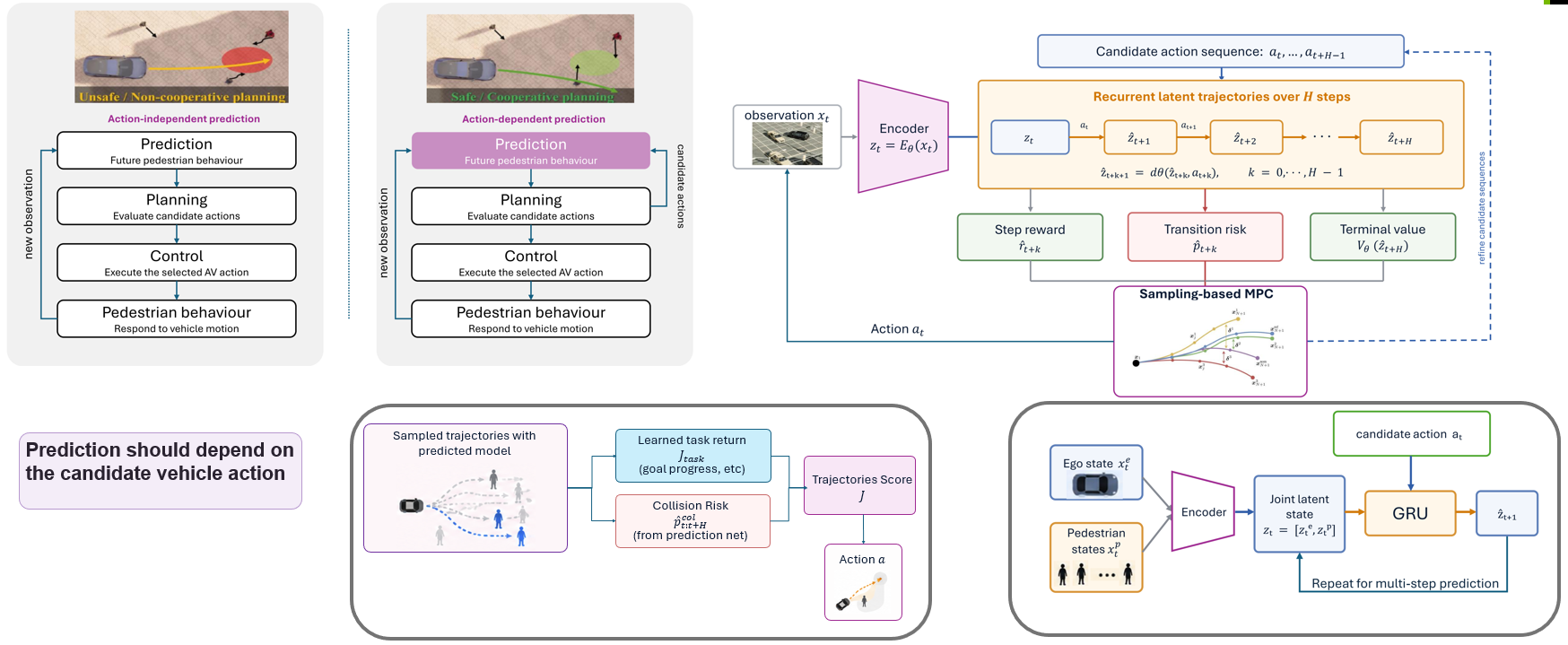
Problem. In crowd navigation, prediction and planning are coupled: a vehicle slowing, turning, or continuing forward can change nearby pedestrian behaviour. Predicting other agents independently from the ego action can therefore lead to poor planning decisions.
Contribution. I developed a recurrent latent world-model architecture that combines action-conditioned dynamics, pedestrian-interaction modelling, collision-risk prediction, reward/value estimation, and sampling-based predictive planning. Candidate action sequences are rolled forward in latent space and evaluated through MPPI-style control.
Results. The best reported configuration reached 99.9% success in the evaluated benchmark and improved out-of-distribution success by 4.8 percentage points in the reported transfer setting.
Tech: PyTorch · Model-Based RL · TD-MPC-style latent prediction · recurrent dynamics · attention · collision prediction · MPPI/MPC · CARLA · custom simulation
Publication: G. Yang, A. S. Chen, A. Parisio, and G. Herrmann, “PIP-CN: Prediction-Integrated Planning for Crowd Navigation,” IEEE/RSJ IROS 2026. Repository record
Safety-Aware MPPI under Prediction Uncertainty
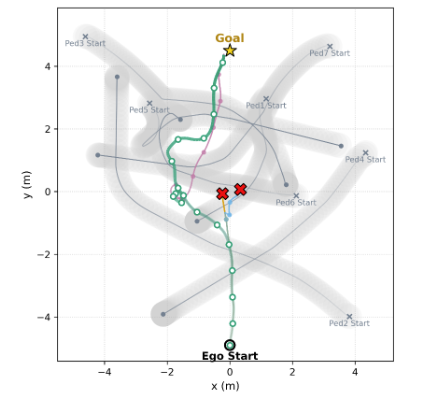
Problem. Standard MPPI can penalise risky trajectories, but the command finally applied to the system is an importance-weighted combination of sampled controls. Soft trajectory penalties alone do not directly guarantee that the executed first-step action satisfies a safety condition, especially with uncertain pedestrian forecasts.
Contribution. I developed a two-layer safety framework that separates long-horizon risk-aware trajectory shaping from execution-level action filtering. Robust CBF-based costs and CVaR emphasise tail-critical interactions during planning, while a current-time convex safe set constrains the action that is actually executed.
Results. Across the broader safety-aware control studies, the proposed methods reduced collisions by up to 65.7% relative to the nominal controller in the evaluated benchmarks.
Tech: MPPI · discrete-time CBF · CVaR · robust optimisation · uncertainty sampling · nonlinear vehicle dynamics · quadratic programming
Publication: G. Yang, A. S. Chen, A. Parisio, and G. Herrmann, “A Safety Framework for Uncertainty-Aware Model Predictive Path Integral Control in Shared-Space Navigation,” IEEE CDC 2026. Repository record
Real-Time Multi-Obstacle Safety Filtering
Problem. Applying one online safety constraint per moving obstacle can increase computational burden as pedestrian density grows.
Contribution. I developed a compact discrete-time CBF safety-filter formulation that aggregates moving-obstacle safety information into a small online correction layer for sampling-based predictive control.
Results. Across 500 evaluated scenarios, the filter reduced collision rate from 7.8% to 3.8% with a reported 9.30 ms runtime.
Tech: discrete-time CBF · multi-obstacle constraints · quadratic programming · real-time control · scenario-based evaluation
Risk-Bounded Predictive Control in Shared Spaces
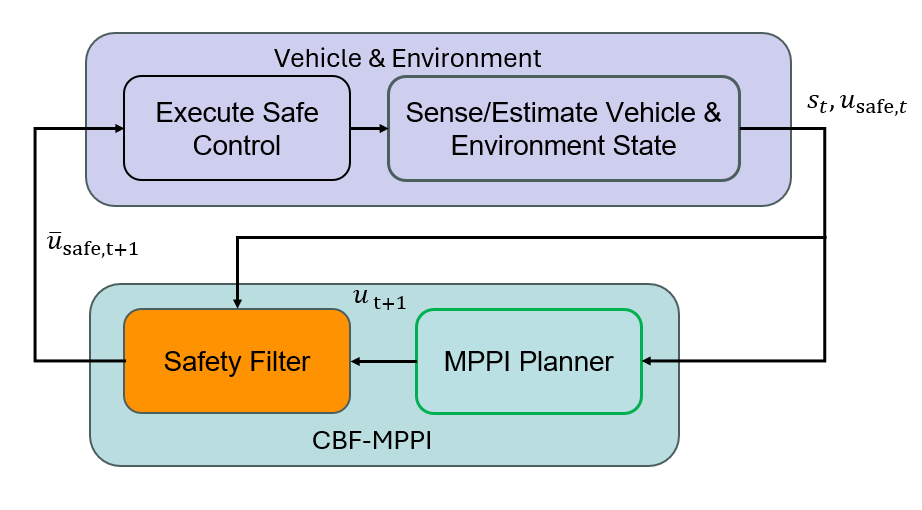
This work studies uncertain pedestrian forecasts using a local, sample-based CVaR safety interpretation. A nominal MPPI command is corrected when predicted tail risk exceeds a prescribed risk budget, using a convex quadratic program with vehicle-input bounds.
Publication: G. Yang, A. S. Chen, A. Parisio, and G. Herrmann, “Risk-Bounded Predictive Control for Automated Vehicles in Shared-Space Areas,” International Symposium on Advanced Vehicle Control (AVEC), 2026.
Hierarchical Pedestrian Forecasting for Autonomous-Vehicle Simulation
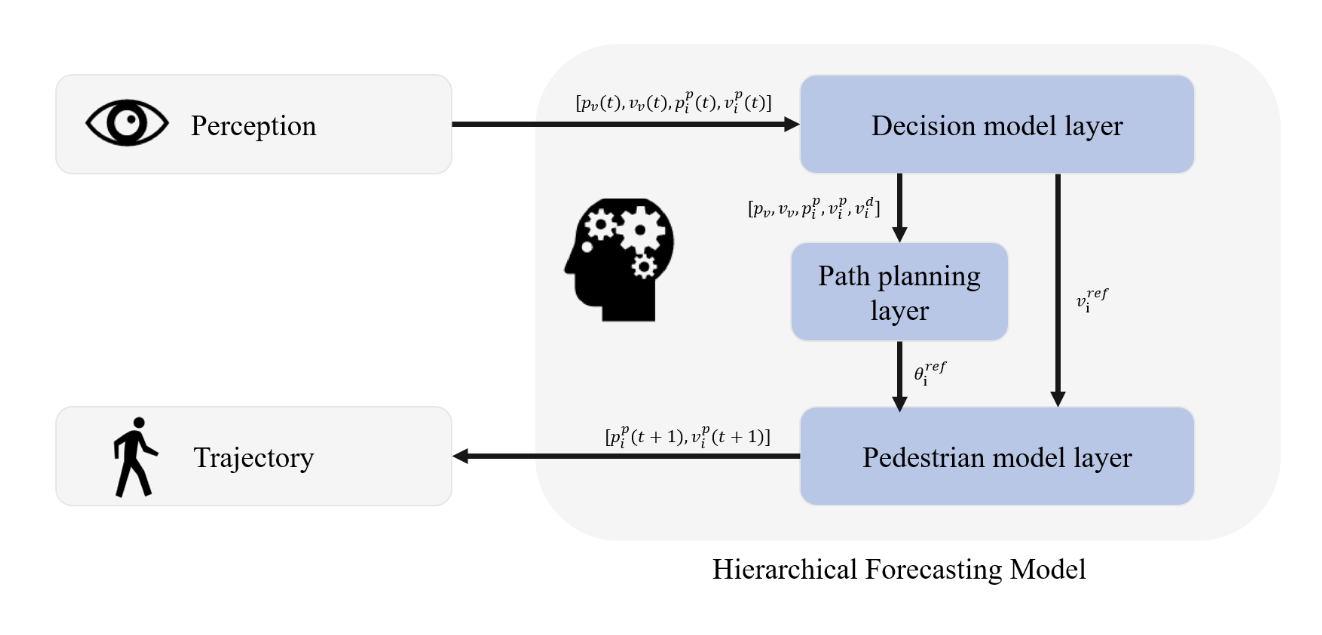
Before the world-model work, I developed a hierarchical pedestrian model for shared-space simulation. The model combines pedestrian dynamics, path planning, and decision layers so simulated pedestrians can respond to vehicle behaviour rather than following fixed trajectories.
Publication: G. Yang, E. J. Lopez Pulgarin, and G. Herrmann, “A Hierarchical Forecasting Model of Pedestrian Crossing Behaviour for Autonomous Vehicle,” IEEE Access, vol. 12, pp. 9025–9037, 2024. DOI
Vehicle Dynamics, MPC and Autonomous Racing
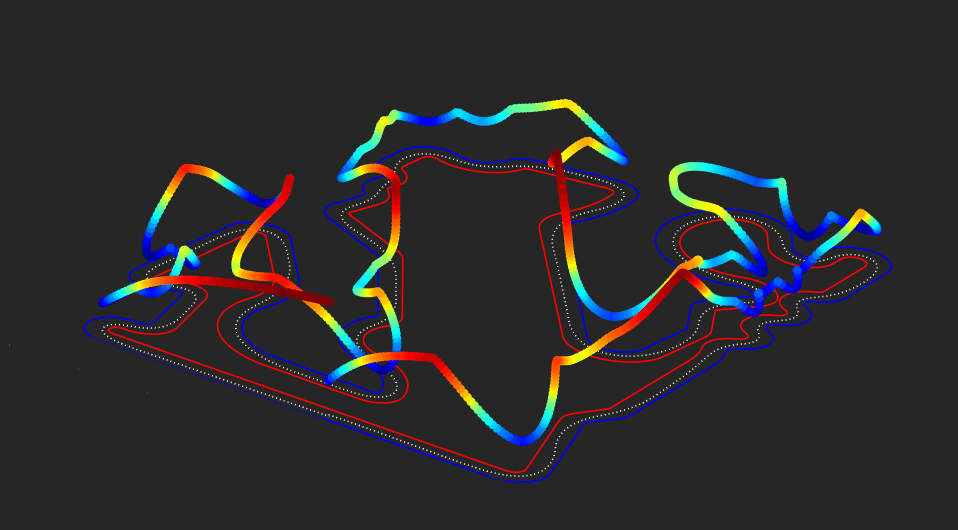
My vehicle-engineering foundation includes four-wheel vehicle dynamics, Pacejka tyre-force modelling, MPC-based trajectory planning and tracking, and IPG CarMaker closed-loop simulation. This physical modelling and control background later connected naturally to learned predictive models and sampling-based planning.
Tech: MATLAB · MPC · Pacejka tyre model · IPG CarMaker · vehicle dynamics